
Understanding Robotic TKR, Knee Joint Replacement with Robotic Assistance
By Tim RS Pondok Indah
Thursday, 01 October 2026


Robotic total knee replacement offers a swifter, less painful recovery, with better long-term knee function and a lower risk of complications
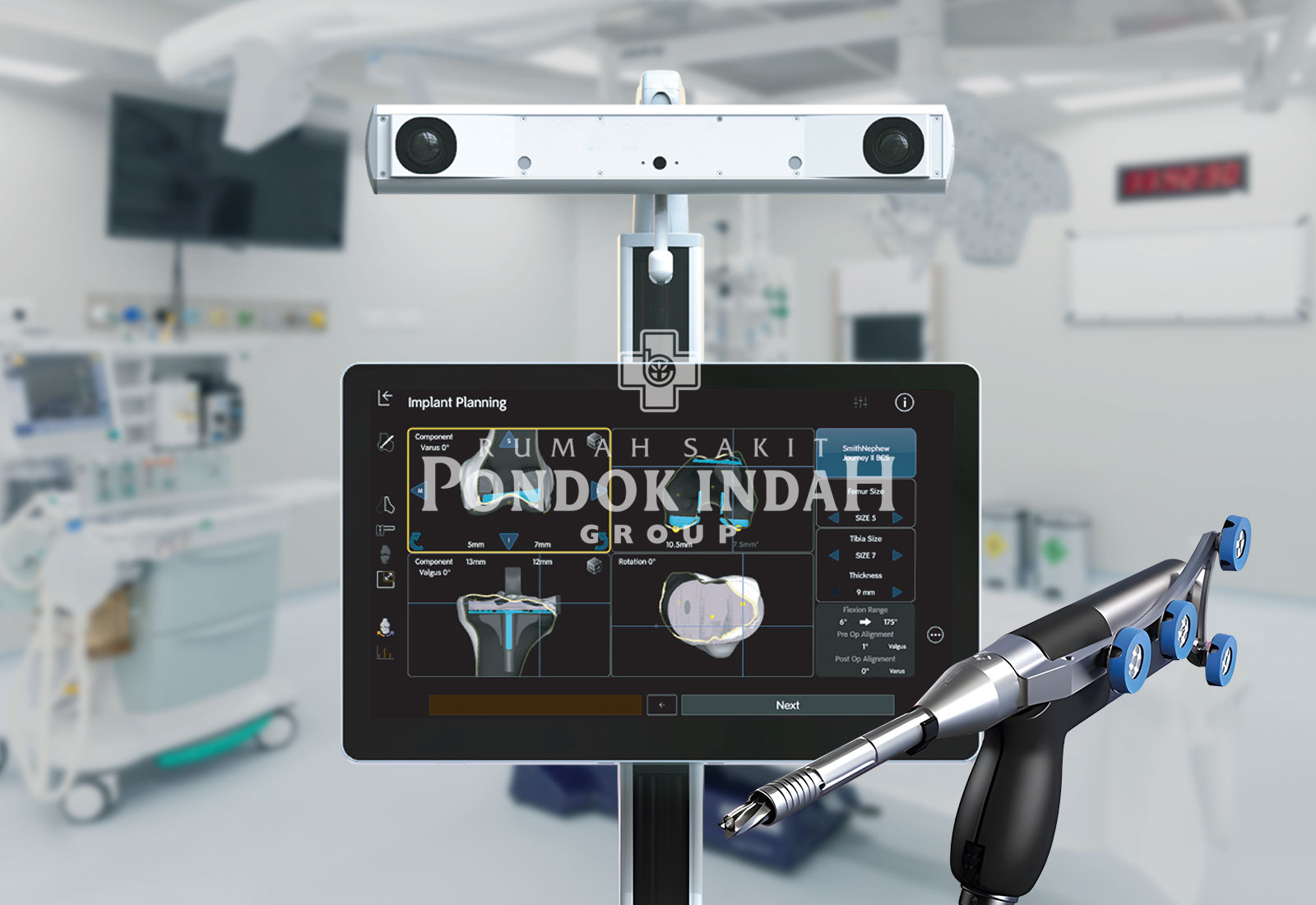
Robotic total knee replacement is the right choice if you want a swifter, less painful recovery. Compared with conventional total knee replacement, this procedure also affords better long-term knee joint function and carries a lower risk of complications.
What Is the Robotic Total Knee Replacement Procedure?
Total knee replacement is a medical procedure to replace a damaged knee joint with an artificial, or prosthetic, joint. It is generally intended for patients with osteoarthritis, joint inflammation, rheumatoid arthritis, or a knee injury.
Knee replacement surgery may be performed with the assistance of a robot, known as robotic total knee replacement (robotic TKR). Despite its name, the robotic total knee replacement procedure is not performed by a robot itself. The robotic technology only helps the surgeon map the patient's knee anatomy and guide the course of the operation for greater precision.
With this robotic assistance, the process of cutting the bone and fitting the artificial knee joint becomes more accurate than in conventional knee replacement surgery.
Read also: Understanding Arthroscopy, a Procedure of Value in Diagnosing and Treating Joint Problems
Conditions Treated with Robotic Knee Surgery
The robotic knee joint replacement procedure is performed when a joint disorder has already caused severe damage. Osteoarthritis is the condition most often addressed with this robotic knee replacement procedure, as it is more precise, minimally invasive, affords a swifter recovery, and delivers a more satisfying result.
Beyond this, the robotic TKR procedure can also be used to address rheumatoid arthritis and post-traumatic arthritis, as well as to revise the result of a previous knee operation.
Advantages of Robotic Knee Surgery
Compared with conventional knee replacement surgery, the robotic knee joint surgery procedure offers the following advantages:
- A more precise, accurate result
- A shorter recovery time
- A reduced need for pain medication
- A lower risk of complications
- Greater flexibility of movement for the patient
Preparation for Robotic Total Knee Replacement
Before undergoing robotic total knee replacement, the orthopaedic specialist conducts a thorough medical examination, including an X-ray, blood tests, or an MRI, to consider whether this procedure is suited to your condition.
Where robotic total knee replacement proves suitable for addressing your knee joint damage, the orthopaedic physician explains the preparations required, notably:
- Adjustment of current medications
- Stopping smoking
- Stopping alcohol consumption
- Losing weight
- Managing any existing illness
The physician then maps the patient's knee anatomy in 3D with the aid of robotic technology. This technology uses specialised software to design the angle of the bone cuts, along with the size and position of the artificial knee joint.
The Robotic Total Knee Replacement Procedure
Once the patient has prepared and the physician has completed planning the operation with robotic technology, the operation is ready to proceed. A robotic TKR operation usually takes 1 to 2 hours, depending on each patient's condition.
The following is the general procedure for knee replacement with robotic technology:
- The patient is given anaesthesia, either general or local, depending on their condition
- Once the anaesthetic has taken effect, the physician begins making a small incision, 10 to 15 cm in length, at the knee
- The physician begins cutting the damaged bone with the guidance of robotic navigation
- Once cut, the orthopaedic surgeon removes it and replaces it with the artificial knee joint, at the position determined by the robot
- Once fitted perfectly, the physician sutures the incision
- The physician may then move the patient's knee to confirm that the artificial joint functions well and remains stable
- Finally, the wound is dressed with a bandage to prevent contamination
After Robotic Total Knee Replacement
Following robotic knee replacement surgery, the patient is transferred to the ward to undergo the recovery process. The patient can usually stand and begin walking within 1 day of surgery.
During the first week of recovery, the patient generally requires a walking aid, notably a cane or crutches. The physician also prescribes pain medication to address any discomfort experienced during recovery. Recovery time may vary for each patient, but a patient who has undergone robotic knee surgery generally recovers more swiftly than one who has undergone conventional TKR surgery.
Complications of Robotic Total Knee Replacement
This procedure carries a low risk, though this does not mean it carries no risk at all. The possible complications of robotic total knee replacement include:
- Infection
- Bleeding
- Blood clotting
- Chronic pain
- Damage to tissue, a nerve, or a blood vessel
- An allergy to the implant material
- Revision surgery
The robotic total knee replacement procedure offers a range of advantages over conventional knee replacement surgery, including a swifter, less painful recovery. Not every case of knee joint damage, however, can be addressed with this procedure. For this reason, you should first consult an orthopaedic specialist at your nearest RS Pondok Indah branch.
Dr. dr. L. Andre Pontoh, Sp.OT (K) is an orthopaedic consultant specialising in Knee and Sports Medicine, experienced in examining and managing knee problems, particularly in performing robotic total knee replacement. Please click here to secure a consultation appointment with Dr. dr. L. Andre Pontoh, Sp.OT (K) at RS Pondok Indah.
Beyond being performed by experienced specialists, robotic knee surgery at RS Pondok Indah uses high quality implants and advanced technology. With this, the care you receive will be more optimal, allowing you to return to your activities free of the knee pain that has long troubled you.
FAQ
Who Can Undergo Robotic Knee Replacement (TKR)?
A patient suited to robotic knee replacement surgery is one who has severe knee joint damage owing to osteoarthritis, joint inflammation, or a knee injury.
Even so, the patient must still consult an orthopaedic surgeon at their nearest hospital to determine whether robotic TKR is the appropriate choice.
Who Should Not Undergo Robotic Total Knee Replacement?
An individual with a particular condition should not undergo robotic total knee replacement, notably one experiencing an active infection, a blood clotting disorder, a muscle function problem, or a severe systemic disease such as heart failure. An older individual, or one who is obese, likewise requires further evaluation before undergoing robotic knee replacement surgery.
Is Robotic TKR Surgery Safe?
Robotic TKR surgery is generally safe. Indeed, the use of robotic technology can enhance the accuracy of implant placement and may reduce post-operative pain, along with affording a swifter recovery. With the support of an experienced physician and careful planning, robotic TKR surgery can be a good option for addressing knee joint damage.
What Anaesthesia Is Used for Robotic TKR Surgery?
Robotic TKR surgery is usually performed under general or regional anaesthesia (epidural or spinal). General anaesthesia puts the patient to sleep throughout the procedure, while regional anaesthesia numbs the lower body. The surgeon and anaesthesia team evaluate the patient's health to determine the safest, most comfortable method of anaesthesia.
How Long Is Recovery from Robotic Total Knee Replacement?
Recovery following robotic TKR is usually swifter than with the conventional method. Generally, the patient can begin moving the knee joint within 24 hours of surgery. The patient can then return to light activity within a matter of weeks. With good post-operative care and a physiotherapy programme, most patients recover fully within a few months.
References:
- Szczęsny G, Kopec M, et al. Toxicity, Irritation, and Allergy of Metal Implants: Historical Perspective and Modern Solutions. Coatings. 2025. (https://www.mdpi.com/2079-6412/15/3/361). Accessed 14 June 2025.
- Alrayes M, Sukeik M. Robotics in total knee replacement: Current use and future implications. 2024. (https://pmc.ncbi.nlm.nih.gov/articles/PMC11212528/). Accessed 14 June 2025.
- American Academy of Orthopaedic Surgeons. Robotic-Assisted Joint Replacement. (https://orthoinfo.aaos.org/en/treatment/robotic-assisted-joint-replacement/). Last revised September 2022. Accessed 14 June 2025.
- Cleveland Clinic. Arthroplasty (Joint Replacement). (https://my.clevelandclinic.org/health/treatments/21649-arthroplasty-joint-replacement). Last revised 2 January 2024. Accessed 14 June 2025.
- Cleveland Clinic. Knee Replacement. (https://my.clevelandclinic.org/health/treatments/8512-knee-replacement). Last revised 18 July 2023. Accessed 14 June 2025.
- Cleveland Clinic. Robot-Assisted vs. Manual Total Knee Replacement: It's a Tie, for Now. (https://consultqd.clevelandclinic.org/robot-assisted-vs-manual-total-knee-replacement-its-a-tiefor-now). Last revised 6 March 2023. Accessed 14 June 2025.
- Mayo Clinic. Knee replacement. (https://www.mayoclinic.org/tests-procedures/knee-replacement/about/pac-20385276). Last revised 15 November 2024. Accessed 14 June 2025.
- Mayo Clinic. Orthopedic Surgery. (https://www.mayoclinic.org/departments-centers/robotic-orthopedic-surgery/overview/ovc-20472153). Last revised 2 October 2024. Accessed 14 June 2025.